NEWS: DBU supports Tübingen startup
Osnabrück/Tübingen. According to the Federal Environment Agency, around 86 million tonnes of rubble and waste are generated on construction sites in Germany every year. Often, these materials end up in landfills. However, this means that valuable resources are lost. The solution: high-quality recycling of the rubble prevents climate-damaging emissions and keeps valuable materials in the recycling loop – and with certified equivalent quality. In order to automate the recycling of material in the construction sector, the startup Optocycle from Tübingen is developing a system based on artificial intelligence (AI) for real-time monitoring. The German Federal Environmental Foundation (DBU) is funding the project with around 170,000 euros.
Real-time quality monitoring in the production of recycled aggregates
More environmental protection in the construction industry: the team from the startup Optocycle (picture) from Tübingen is developing an AI-supported process for recycling construction waste. The German Federal Environmental Foundation (DBU) is funding the project with around 170,000 euros.

The Optocycle team is delighted about the renewed DBU funding ©Optocycle GmbH
DBU Secretary General Alexander Bonde sees great potential for more environmental protection in the construction industry. Here, medium-sized businesses could serve as role models with innovative solutions. Bonde: "The construction of new buildings already follows clear guidelines for more efficiency and sustainability. The same must also be observed in future after the demolition of houses and structures." An approach for this is provided by the startup Optocycle GmbH from Tübingen. As part of the DBU Green Startup Funding, they have developed an AI-based system for the automatic, reproducible classification of construction waste. Building on this, a prototype is now to enable the real-time monitoring of recycled aggregates from construction waste. The DBU is funding the project with around 170,000 euros. Optocycle co-founder Max-Frederick Gerken: "At present, the processing of construction rubble in the industry is mostly based on subjective estimates." The final product is also only tested on a random basis in the laboratory. With the Optocycle system, in Gerken's words, "real-time monitoring of recycled aggregates is possible. This allows the quality of the aggregate to be improved and more material to be transferred into concrete production," says Gerken.
Less waste in the landfill
According to Gerken, the system combines modern optical sensor technology with artificial intelligence – and thus solves a well-known problem in the construction industry. The startup co-founder: "At present, the consistency of recycled raw materials often fluctuates. On the one hand, this represents a financial risk for companies and, on the other, leads to the loss of valuable materials." With the help of its development, Optocycle expects a 20 percent higher volume of recycled, high-quality aggregates as well as 15 percent fewer waste residues that would otherwise end up in landfills. To achieve this, according to Gerken, both the incoming rubble is "optimally classified" and the result is transparently verified. The cooperation partner here is Heinrich Feeß GmbH, which according to Gerken has already been working with Optocycle for many years. The co-founder continues: "The technology contributes to the circular economy in the construction industry. We help to improve the quality of secondary raw materials obtained from construction waste. In future, this solution can also be transferred to all waste streams."
Simple retrofitting in existing construction waste recycling plants
According to Gerken, the Optocycle system can be installed directly into existing plants for processing construction waste – "directly above the conveyor belt." This simple retrofitting saves costs and enables the rapid implementation of innovative construction waste recycling. "Because only if recycling is financially viable can the circular economy succeed in the construction sector," says Gerken – an approach that was also in the foreground of the startup funding by the DBU. Here, the developed system convinced with its high accuracy in the classification of different construction rubble. According to Gerken, this is now to be built upon in order to make the circular economy in concrete production more attractive with high-quality secondary raw materials.
Every good solution provides enormous relief for the climate
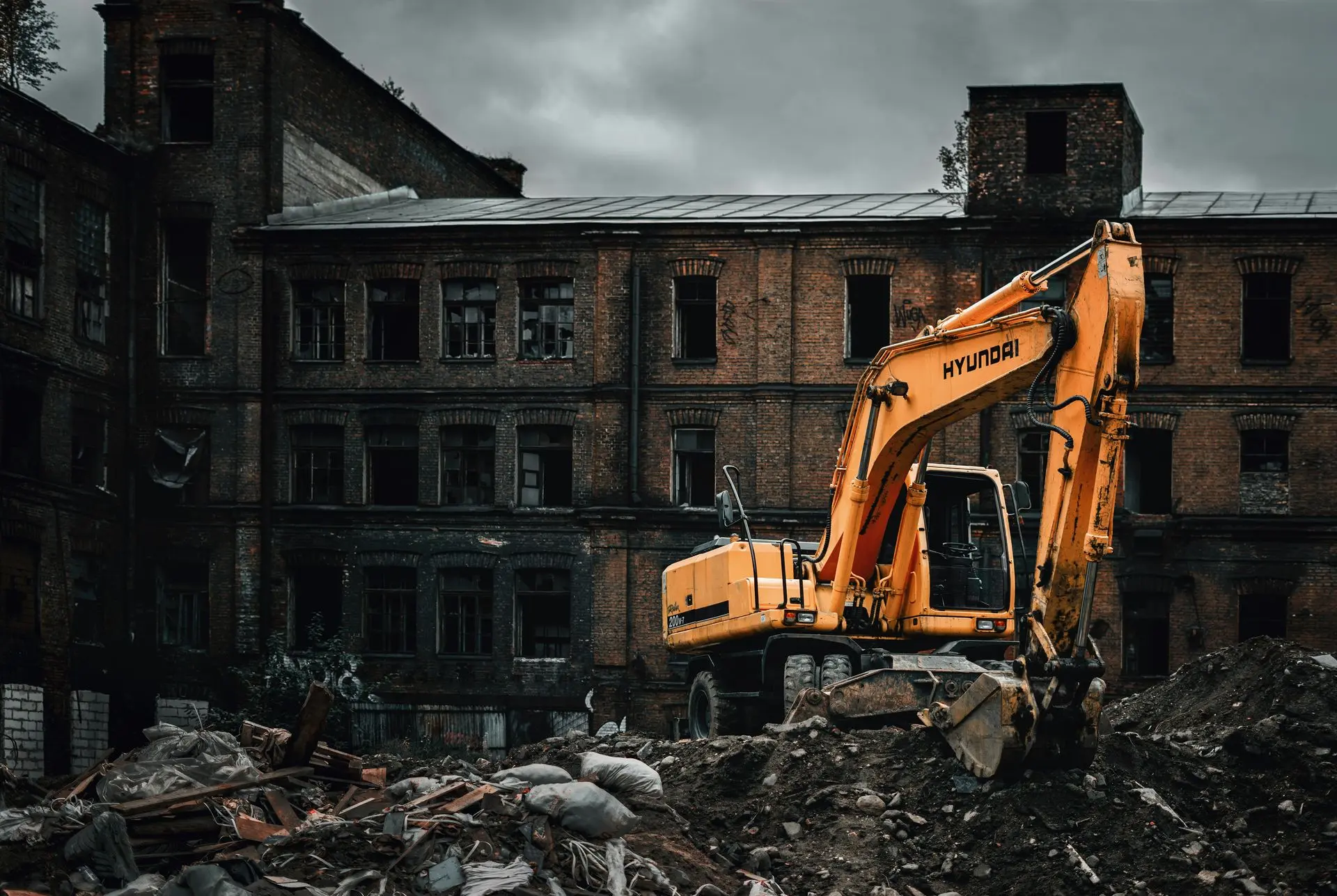
First demolition, then recycling: around 86 million tonnes of construction waste are generated nationwide every year. For reuse, Optocycle is developing a sophisticated process with around 170,000 euros in funding from the German Federal Environmental Foundation (DBU).
According to the responsible DBU consultant Dr Volker Berding, the circular economy in the construction sector has important effects for climate protection: "The production of new concrete leads to high emissions of climate-damaging greenhouse gases." According to a WWF study, the production of cement, the most important component of concrete, accounts for eight percent of total global greenhouse gas emissions. Berding: "Anything that contributes to an emission reduction therefore already has a major effect on climate protection." However, a circular economy only works "if the quality of secondary raw materials does not differ from that of new production. It is precisely this step that Optocycle can take with a scalable, optimised prototype."