How Feeß achieves 80% fewer misclassifications with Optocycle
- and changed the industry -
Some partnerships begin with a handshake and end with an order. And some change an entire industry. The collaboration between Optocycle and Heinrich Feeß GmbH & Co. KG from Kirchheim unter Teck belongs to the second category. Feeß was Optocycle's first customer – and at the same time the sparring partner who helped to turn an idea into a market-ready product. Today, Eberhard Fritz, Material Flow Manager at Feeß, estimates 80% fewer misclassifications thanks to Optocycle's solution. No more discussions with suppliers. Solid data instead of gut feeling.
The customer: Heinrich Feeß GmbH & Co. KG – pioneer of the circular economy
Heinrich Feeß GmbH & Co. KG is no ordinary recycling company. The family business from Kirchheim unter Teck, located between Stuttgart and the Swabian Alb, has for decades been considered one of the most innovative players in mineral construction waste recycling in Germany. With six recycling centres and storage sites in the Stuttgart region, over 200 employees and a recycling rate of up to 80% of the input material, Feeß consistently implements what is still an aspiration in many other companies: a true circular economy.
Managing Director and namesake Walter Feeß was awarded the German Environmental Prize by the German Federal Environmental Foundation (DBU) in 2016 – for his consistent strategy of processing construction waste into recyclate that can be mixed directly into concrete. He is still regarded as a pioneer in the industry today.
And it is precisely this spirit of innovation that has driven Feeß to be there from the very beginning – when Optocycle was still a Tübingen-based startup with an idea and a camera.
The beginning: When Feeß showed Optocycle the way
The story of this partnership begins in 2022 – and it begins with a geologist who introduced a founder to the reality of the industry.
When Max-Frederick Gerken found his way to Feeß through a contact from the recycling industry, it was Eberhard Fritz, Material Flow Manager and geologist at Feeß, who received him. What followed was more than an initial sales pitch: Fritz became a congenial sparring partner. He introduced the founder to the details of an industry that looks simple from the outside, but is not – and he provided the raw material that every algorithm needs to learn: data.
Together with the Optocycle team, Fritz photographed countless materials from all directions, under different lighting conditions, wet and dry, in the shade and in the sun. Grain size, edge length, composition, degree of contamination – everything that a human eye can recognize on a truck load had to be learned by the machine learning model first. Fritz played a key role in shaping this learning curve.

“We use Optocycle because it saves us discussions with suppliers. A solid database is always better than having to weigh up different opinions against each other."
Eberhard Fritz
Head of Material Flow, Heinrich Feeß GmbH & Co. KG
This quote gets to the heart of what Optocycle does: objectivity. No more two people with different assessments, no more subjective visual inspection, no more uncertainty in invoicing. Instead, reproducible, image-based facts – at the moment of delivery.

“The Feeß company was our first customer – but above all our first real partner. Eberhard Fritz showed me how the industry really works, which materials appear in which variations and what a machine learning algorithm really needs to be able to do to survive in everyday life. Without this close collaboration from the very start, we would not be where we are now."
Max-Frederick Gerken
Co-Founder & CEO, Optocycle GmbH
The technology in action: Truck Imager directly at the truck scale
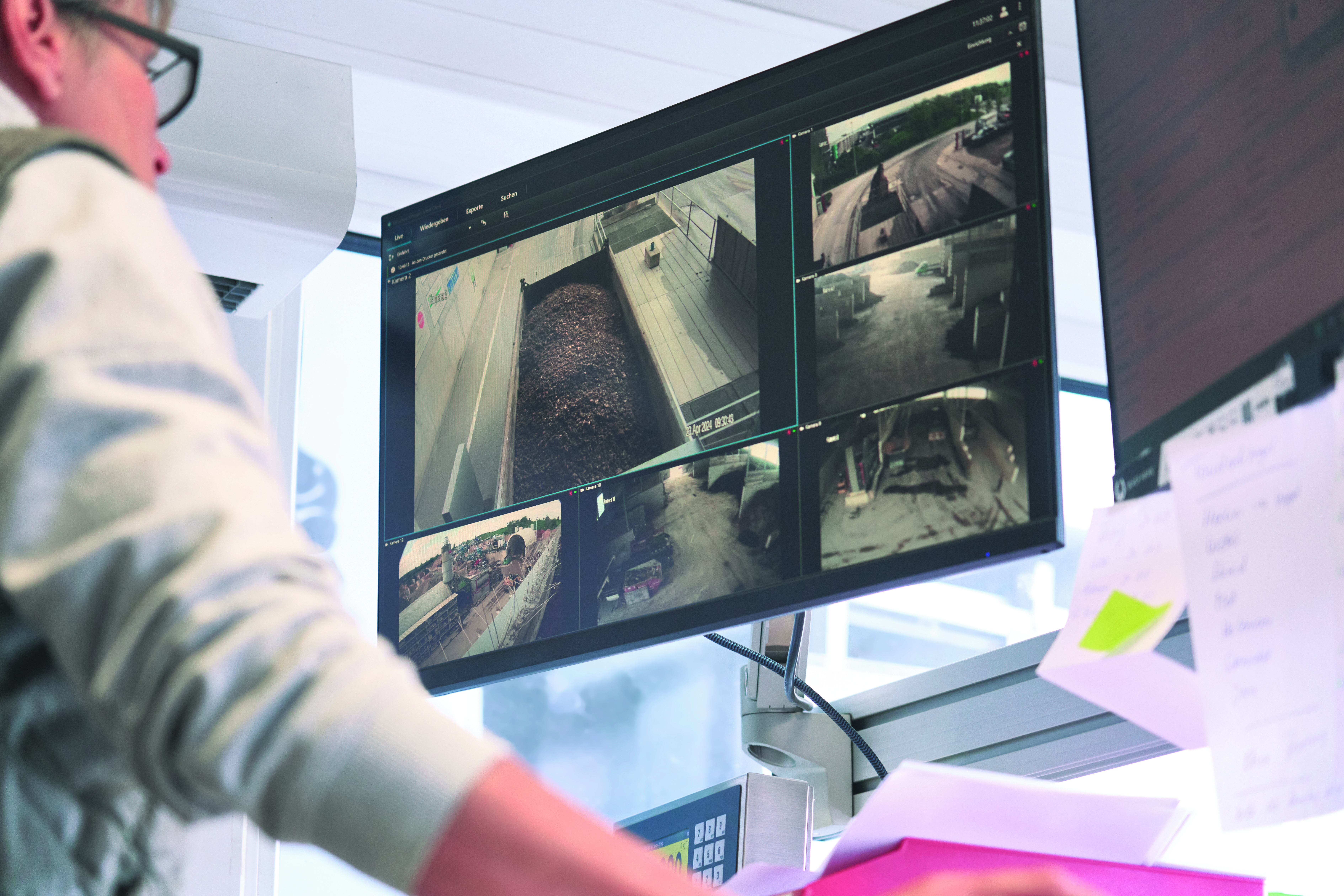
Shortly after the initial contact, the first camera was installed above the truck scale at the entrance to the recycling yard in Kirchheim unter Teck. Since then, every incoming truck passes the system – and is automatically recorded.

The Optocycle Truck Imager performs several tasks at the same time:
Automated delivery recording: Each load is documented based on images, without the weighmaster having to intervene.
AVV classification: The system creates a reliable database for classification according to the waste catalogue – a decisive advantage with regard to regulatory requirements and the Substitute Building Materials Ordinance (Ersatzbaustoffverordnung).
Recognises material attributes in real time: The algorithm determines the composition of the delivered material and even detects very small grain sizes.
Detection of oversized edge lengths: Deliveries with materials that exceed the permitted dimensions are automatically detected.
Legally compliant documentation: Image and material data are available at all times in a transparent manner – as a basis for invoicing and for any complaints.
The result: 80% fewer misclassifications
Since introducing the Optocycle system, Eberhard Fritz estimates approx. 80% fewer misclassifications during material intake. What used to happen: experienced inspectors differed in their assessment by up to 20%. Inexperienced or conflict-averse employees hesitated to reject loads or classify them correctly. The result: incorrectly evaluated materials in processing, reductions in grade purity, unnecessary discussions with suppliers.
What happens today: The system provides an objective, image-based assessment – regardless of the time of day, the inspector's level of experience or the truck driver's negotiating skills. Misclassifications are drastically reduced. Discussions with suppliers are almost completely eliminated. And since Feeß operates six locations, the technology opens up another advantage in the future: standardized quality assurance across all yards – with identical standards everywhere.
More than practical application: Two DBU research projects with Feeß as cooperation partner
The collaboration with Feeß went far beyond operational application. In two research projects funded by the German Federal Environmental Foundation (DBU), Heinrich Feeß GmbH was the central practical partner – and thus co-responsible for turning a pilot into an industrial-ready technology.
DBU Project 1: Automatic classification of construction waste
In the first DBU project, Optocycle developed an AI-based system for the automatic, reproducible classification of construction waste. The pilot plant ran directly at Feeß's operations in Kirchheim unter Teck – the plant of the environmental prize winner at the time, Walter Feeß. The entrance scale was the first real test point: here, the system was tested, improved and validated under real conditions.
In this phase, Eberhard Fritz provided the industry expertise that turned the machine learning model into what it is today: a recognition system that knows the variety and variance of real construction waste deliveries – not just idealised laboratory conditions.
DBU Project 2: Real-time monitoring of recycled aggregates
The follow-up project went a decisive step further: in collaboration with Feeß, Optocycle developed a fully validated prototype for real-time monitoring of recycled aggregates – i.e. recycled mineral aggregates directly in the processing flow. The aim is to continuously and automatically monitor the quality of the secondary raw materials produced – no longer randomly in the laboratory, but seamlessly in the ongoing production.
This means that Optocycle monitors the material flow not only at the intake, but all the way into processing. For Feeß, which produces up to 40 different quality recycled construction materials, this is a decisive step towards consistent, certifiable product quality.
The cooperation partner in both projects is Heinrich Feeß GmbH – the company of the 2016 environmental prize winner, Walter Feeß.
Why this is important for the entire industry
Germany generates around 220 million tonnes of mineral construction waste every year. A large proportion of this ends up in landfills or is recycled in low quality – because grade purity is difficult to guarantee and quality fluctuations are hard to control.
This is exactly where Optocycle comes in. And Feeß is proof that it works:
Higher grade purity through objective, automated intake control
Better resource utilization through precise allocation of materials to the correct processing lines
Legal certainty through seamless, image-based documentation in accordance with AVV and the Substitute Building Materials Ordinance
Standardization across multiple locations – with identical quality assurance everywhere
Less landfilling through higher-value processing of more material
“With the knowledge gained about what is on the truck loads, recycling companies can start processing in a targeted and efficient manner and better categorize and invoice the materials received."
Max-Frederick Gerken, Co-Founder & CEO, Optocycle GmbH
Conclusion: Some partnerships are more than just business

Feeß was Optocycle's first customer. Eberhard Fritz was the first industry expert who truly participated – who contributed his data, his knowledge and his critical questions to turn a good idea into a working product. And Walter Feeß's facility was the first real proof that AI-supported material recognition in construction waste recycling is not a pipe dream, but is having an impact here and today.
Today, Feeß benefits from a technology that they helped to develop. And through this partnership, Optocycle has set a standard that points far beyond a single business: transparency in the material flow is not a luxury – it is the prerequisite for high-quality recycling.
Feeß and Optocycle are continuing to work on this together.
Would you like to find out how Optocycle can make your recycling business more efficient and transparent too? Arrange a non-binding consultation now via THIS LINK.