Cutting-Edge Computer Vision Technology in Small Recycling Centres

The Hiller family shows how it's done

28.07.2026 · Laura Neusser

Many operators of small recycling centres assume that automated material recognition is only for the big players. Too complex, too expensive, too much system for just a few deliveries per day. BHRZ Parsberg didn't think so – and since early 2026, they've been demonstrating why this assumption can be a costly mistake.

What is BHRZ Parsberg?

BHRZ Bauschutt- und Holzrecycling Zentrum Parsberg GmbH is a modestly sized recycling business in Parsberg, in the Upper Palatinate region, right in the heart of the Bavarian Jura. Around 20 deliveries arrive there every day – not a massive operation, but a business with clear standards of quality. The company accepts mineral construction waste, timber, plastics, scrap tyres and other recyclable materials, processing them responsibly.

Managing directors Silvester and Fritz Hiller have been running Fritz Hiller GmbH for years, an established business in the natural stone trade – deeply rooted in a region famous for its limestone. BHRZ is their new venture: same region, new premises, new sector – but with the exact same commitment to quality.

The argument that counts: A single misthrow is all it takes

Mineral construction waste sounds like a straightforward material flow. But it isn't. Plasterboard, aerated concrete or asbestos ending up in the wrong pile can render an entire batch unrecyclable – with immediate consequences for revenues, disposal costs and regulatory compliance.

And that is precisely the core of the issue: with around 20 deliveries a day, only a single one needs to go wrong to cause significant damage. A lower volume doesn't protect you – it merely shrinks the window of time before a mistake becomes apparent.

Silvester Hiller was well aware of this when establishing BHRZ. That's why he looked for a solution to automate delivery checks early on – and reached out to Optocycle via email.

Silvester Hiller

— Managing Director, BHRZ Parsberg

“Even with a smaller volume of deliveries, it makes perfect sense – because individual misthrows can have enormous economic consequences.”

From the first phone call to installation

Optocycle co-founder Max-Frederick Gerken recalls the initial contact: “During the first phone calls with Silvester, we hit it off straight away.” The subsequent online meeting went, in his words, “incredibly well and successfully” – both generations of the Hiller family were convinced right from the start.

An on-site visit in the Bavarian Jura followed. Together, they analysed the site, the entrance, the logistics – and determined the best position for the Truck Imager. The installation went swiftly. The system has been in productive use since early 2026.

How the Truck Imager works – even with low volumes

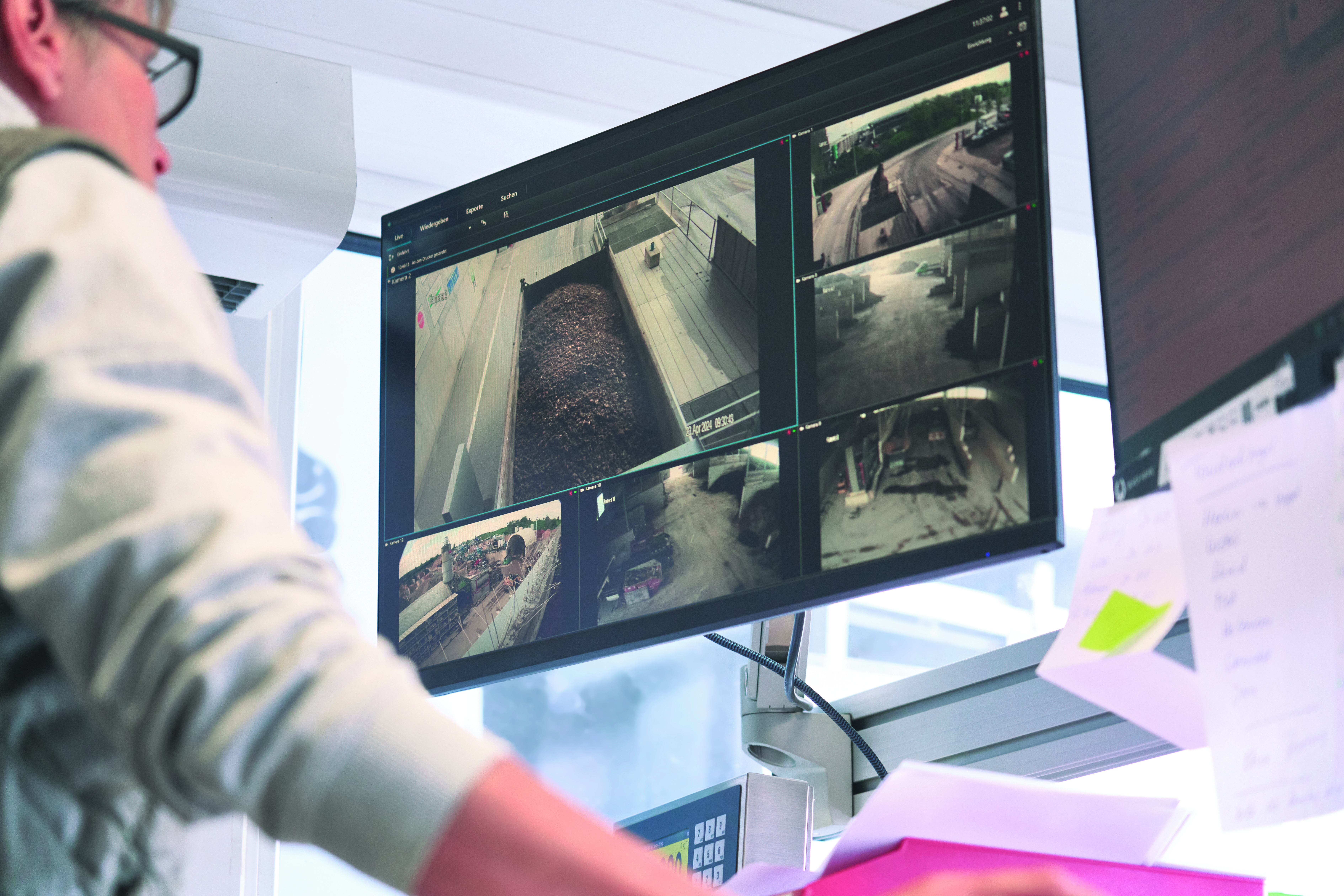
The Truck Imager is Optocycle's machine learning solution for automatic material recognition directly at the weighbridge. The camera captures the bed of every incoming lorry during the weighing process. A machine learning model analyses the image in real time via edge computing and instantly provides an objective assessment of the material composition – including contaminants.

This is crucial, particularly for smaller yards like BHRZ:

  • Every single delivery counts – with only a few lorries per day, there is no high volume to cushion the blow of an error
  • No staff required – the system runs fully automatically, without any extra effort on site
  • Objective documentation – in the event of a dispute, you have visual data, not just opinions
  • Growth on a solid foundation – clean documentation from day one allows scaling without blind spots
Insights into the small but impressive recycling centre

Conclusion: Small recycling centres benefit just as much as large ones.

On closer inspection, the argument “We are still too small” turns on its head. Precisely because BHRZ Parsberg is a young, compact business, every misthrow has a disproportionately high impact. Delivery checks supported by computer vision are not a luxury here – they are risk management.

Silvester Hiller puts it in a nutshell: “We wanted to know what was coming in from the very start. No guesswork – actual knowledge.”

If you run a small or medium-sized recycling centre and are wondering whether Optocycle makes sense for you: BHRZ Parsberg is proof that the answer is yes.

Do you run a recycling centre and want to automate your delivery checks? Arrange a non-binding consultation with Optocycle now.

State-of-the-Art Computer Vision Technology in Small Recycling Yards

The Hiller family shows how it's done

28.07.2026 · Laura Neusser

Many operators of small recycling yards think that automated material recognition is only for the big players. Too complex, too expensive, too much system for just a few deliveries a day. BHRZ Parsberg didn't think so – and since the beginning of 2026, they have been demonstrating why this assumption can be a costly mistake.

What is BHRZ Parsberg?

BHRZ Bauschutt- und Holzrecycling Zentrum Parsberg GmbH is a modestly sized recycling business in Parsberg, in the Upper Palatinate region, right in the heart of the Bavarian Jura. They receive around 20 deliveries a day – not a major operation, but one with clear quality standards. The company accepts mineral construction waste, wood, plastic sheeting, old tyres, and other recyclables, processing them responsibly.

Managing directors Silvester and Fritz Hiller have run an established natural stone trading business, Fritz Hiller GmbH, for years – deeply rooted in a region famous for its limestone. BHRZ is their new venture: same region, new site, new industry – but with the same commitment to quality.

The argument that counts: A single incorrect load is all it takes

Mineral construction waste sounds like a straightforward material stream. But it isn't. Gypsum plasterboard, aerated concrete, or asbestos ending up in the wrong pile can make an entire batch non-recyclable – with direct consequences for revenues, disposal costs, and regulatory compliance.

And that is precisely the core of the issue: with around 20 deliveries a day, only one needs to go wrong to cause significant damage. A lower volume doesn't protect you – it just reduces the window of time before an error becomes apparent.

Silvester Hiller was well aware of this when setting up BHRZ. That is why he looked for a solution to automate delivery inspections early on – and reached out to Optocycle by email.

Silvester Hiller

— Managing Director BHRZ Parsberg

“Even with a smaller delivery volume, it makes absolute sense – because individual incorrect loads can have enormous economic consequences.”

From the first phone call to installation

Optocycle co-founder Max-Frederick Gerken recalls the initial contact: “In our first phone conversations with Silvester, we hit it off straight away.” The online meeting that followed went “very well and successfully” in his words – both generations of the Hiller family were convinced from the start.

An on-site visit to the Bavarian Jura followed. Together, they analysed the premises, the entrance, and the logistics – and decided on the best position for the Truck Imager. The installation was carried out swiftly. Since the beginning of 2026, the system has been in active use.

How the Truck Imager works – even with low volumes

The Truck Imager is Optocycle's machine learning solution for automatic material recognition directly at the weighbridge. The camera captures the cargo bed of every incoming lorry during weighing. A machine learning model analyses the image in real time via edge computing and immediately provides an objective assessment of the material composition – including any contaminants.

This is crucial, particularly for smaller yards like BHRZ:

  • Every single delivery counts – with only a few lorries a day, there is no high volume to buffer an error
  • No staff deployment required – the system runs fully automatically, without extra effort on the yard
  • Objective documentation – in the event of a dispute, you have image data, not opinions
  • Growth on a solid foundation – clean documentation from day one means scaling without blind spots
Insights into the small but impressive recycling yard

Conclusion: Small recycling yards benefit at least as much as large ones

On closer inspection, the argument “We are still too small” turns on its head. Precisely because BHRZ Parsberg is a young, modestly sized business, every incorrect load has a disproportionately high impact. Computer vision-supported delivery inspection is not a luxury here – it is risk management.

Silvester Hiller sums it up: “We wanted to know what was coming in from the very start. Not guessing – knowing.”

If you run a small or medium-sized recycling yard and are wondering if Optocycle makes sense for you: BHRZ Parsberg is proof that the answer is yes.

Do you run a recycling yard and want to automate your delivery inspections? Arrange a non-binding consultation with Optocycle now.

State-of-the-art Computer Vision Technology at Small Recycling Centres

The Hiller family shows how it's done

28.07.2026 · Laura Neusser

Many operators of small recycling centres believe that automated material detection is only for the big players. Too complex, too expensive, too much system for just a few deliveries a day. BHRZ Parsberg didn't think so – and since the beginning of 2026, they have been showing why this assumption can be a costly mistake.

What is BHRZ Parsberg?

BHRZ Bauschutt- und Holzrecycling Zentrum Parsberg GmbH is a modestly sized recycling business in Parsberg, in the Upper Palatinate region, right in the heart of the Bavarian Jura. Around 20 deliveries arrive there every day – it is not a massive operation, but one with clear quality standards. The company accepts mineral construction waste, wood, plastic sheeting, old tyres and other recyclable materials, processing them responsibly.

With Fritz Hiller GmbH, managing directors Silvester and Fritz Hiller have been running an established natural stone trading business for years – deeply rooted in a region famous for its limestone. The BHRZ is their new venture: same region, new site, new industry – but with the very same commitment to quality.

The argument that matters: A single incorrect disposal is all it takes

Mineral construction waste sounds like a straightforward material stream. But it isn't. Gypsum plasterboard, aerated concrete or asbestos ending up in the wrong pile can render an entire batch non-recyclable – with direct consequences for revenues, disposal costs and regulatory compliance.

And that is precisely the core of the issue: with around 20 deliveries a day, only a single one needs to go wrong to cause substantial damage. A lower volume doesn't protect you – it merely shrinks the window of time in which a mistake is spotted.

Silvester Hiller was well aware of this when establishing BHRZ. That is why he looked for a solution to automate delivery inspections early on – and got in touch with Optocycle by email.

Silvester Hiller

— Managing Director, BHRZ Parsberg

“Even with a smaller delivery volume, it makes absolute sense – because individual incorrect disposals can have massive financial consequences.”

From the first phone call to installation

Optocycle co-founder Max-Frederick Gerken recalls the initial contact: “In our first phone calls with Silvester, we hit it off immediately.” The subsequent online meeting went, in his words, “incredibly well and successfully” – both generations of the Hiller family were on board right from the start.

This was followed by an on-site visit in the Bavarian Jura. Together, they analysed the premises, the entrance, and the logistics – and decided on the best position for the Truck Imager. The installation went ahead swiftly. The system has been in productive use since early 2026.

How the Truck Imager works – even with low volumes

The Truck Imager is Optocycle's machine learning solution for automatic material recognition directly at the weighbridge. The camera captures the cargo area of every incoming lorry during the weighing process. A machine learning model analyses the image in real time via edge computing and immediately provides an objective assessment of the material composition – including any contaminants.

This is crucial, especially for smaller yards like BHRZ:

  • Every single delivery counts – with only a few lorries per day, there is no massive volume to absorb a mistake
  • No staff deployment required – the system runs fully automatically, without extra effort on site
  • Objective documentation – in the event of a dispute, there is visual data rather than just opinions
  • Growth on a solid foundation – clean documentation from day one means scaling up without any blind spots
Insights into the small but highly efficient recycling centre

Conclusion: Small recycling centres benefit at least as much as large ones

On closer inspection, the argument “we are still too small” actually turns on its head. Precisely because BHRZ Parsberg is a young, manageable business, any incorrect disposal has a disproportionately high impact. Here, computer vision-based delivery control is not a luxury – it is essential risk management.

Silvester Hiller sums it up perfectly: “We wanted to know what was coming in right from the start. Not guess – know.”

If you run a small or medium-sized recycling centre and are wondering whether Optocycle is right for you: BHRZ Parsberg is the proof that the answer is yes.

Do you operate a recycling centre and want to automate your delivery inspections? Book a no-obligation appointment with Optocycle now.

Some partnerships begin with a handshake and end with an order. And some change an entire industry. The collaboration between Optocycle and Heinrich Feeß GmbH & Co. KG from Kirchheim unter Teck belongs to the second category. Feeß was Optocycle's first customer – and at the same time the sparring partner who helped turn an idea into a market-ready product. Today, Eberhard Fritz, Material Flow Manager at Feeß, estimates 80% fewer misclassifications thanks to Optocycle's solution. No more discussions with suppliers. Solid data instead of gut feeling.

The Customer: Heinrich Feeß GmbH & Co. KG – Pioneer of the Circular Economy

Heinrich Feeß GmbH & Co. KG is no ordinary recycling company. The family business from Kirchheim unter Teck, located between Stuttgart and the Swabian Alb, has for decades been considered one of the most innovative players in mineral construction waste recycling in Germany. With six recycling yards and storage sites in the Stuttgart region, over 200 employees, and a recycling rate of up to 80% on source material, Feeß consistently implements what is still only an ambition in many other companies: a true circular economy.

Managing Director and namesake Walter Feeß was awarded the German Environmental Prize by the German Federal Environmental Foundation (DBU) in 2016 – for his consistent strategy of processing demolition waste into recyclate that can be mixed directly into concrete. To this day, he is considered a pioneer of the industry.

And it is precisely this spirit of innovation that led Feeß to be there from the very beginning – when Optocycle was still a Tübingen-based startup with just an idea and a camera.

The Beginning: When Feeß Showed Optocycle the Way

The story of this partnership begins in 2022 – and it begins with a geologist introducing a founder to the realities of the industry.

When Max-Frederick Gerken found his way to Feeß through a contact from the recycling industry, it was Eberhard Fritz, Material Flow Manager and geologist at Feeß, who received him. What followed was more than a first customer meeting: Fritz became the ideal sparring partner. He introduced the founder to the details of an industry that looks simple from the outside, but isn't – and he supplied the raw material that every algorithm needs to learn: data.

Fritz, together with the Optocycle team, photographed countless materials from all directions, in different lighting conditions, wet and dry, in the shade and in the sun. Grain size, edge length, texture, level of contamination – everything a human eye can recognize on a truckload, the machine learning model had to learn first. Fritz played a decisive role in shaping this learning curve.

Eberhard Fritz

Head of Material Flow, Heinrich Feeß GmbH & Co. KG

“We use Optocycle because it saves us from discussions with suppliers. A solid database is always better than having to weigh different opinions against each other."

This quote sums up what Optocycle delivers: objectivity. No more two people with different assessments, no more subjective visual inspection, no more uncertainty in billing. Instead, reproducible, image-based facts – at the exact moment of delivery.

Max-Frederick Gerken

Co-Founder & CEO, Optocycle GmbH

“The Feeß company was our first customer – but above all, our first true partner. Eberhard Fritz showed me how the industry really works, what materials appear in what variations, and what a machine learning algorithm really needs to be capable of to survive in everyday use. Without this close cooperation from the start, we wouldn't be where we are now."

The Technology in Action: Truck Imager Directly at the Truck Scales

Soon after the first contact, the first camera was installed above the truck scales at the entrance to the recycling yard in Kirchheim unter Teck. Since then, every incoming truck passes the system – and is automatically recorded.

The Optocycle Truck Imager performs several tasks at the same time:

  • Automated delivery recording: Every load is documented using images, without the weighmaster having to intervene.

  • AVV Classification: The system creates a reliable data basis for classification according to the Waste Catalogue – a decisive advantage with regard to regulatory requirements and the Ersatzbaustoffverordnung (Substitute Building Materials Ordinance).

  • Recognizes material attributes in real time: The algorithm determines the composition of the delivered material and recognizes even very small grain sizes.

  • Detection of oversized edge lengths: Deliveries with materials that exceed the permissible dimensions are automatically detected.

  • Legally secure documentation: Image and material data are available and traceable at all times – as a basis for billing and for any complaints.

The Result: 80% Fewer Misclassifications

Since the introduction of the Optocycle system, Eberhard Fritz estimates approx. 80% fewer misclassifications during material intake. What used to happen: Experienced inspectors differed in their assessments by up to 20%. Inexperienced or conflict-averse employees hesitated to reject loads or classify them correctly. The result: incorrectly valued materials in processing, compromises in sorting purity, unnecessary discussions with suppliers.

What happens today: The system delivers an objective, image-based assessment – regardless of the time of day, the inspector's level of experience, or the truck driver's negotiating skills. Misclassifications are drastically reduced. Discussions with suppliers are virtually eliminated. And since Feeß operates six locations, the technology opens up another advantage in the long run: standardised quality assurance across all yards – with identical standards everywhere.

More than Practice: Two DBU Research Projects with Feeß as a Cooperation Partner

The collaboration with Feeß went far beyond operational use. In two research projects funded by the German Federal Environmental Foundation (DBU), Heinrich Feeß GmbH was the central practical partner – and thus co-responsible for turning a pilot into an industrial-grade technology.

DBU Project 1: Automatic Classification of Construction Waste

In the first DBU project, Optocycle developed an AI-based system for the automatic, reproducible classification of construction waste. The pilot plant ran directly at the Feeß facility in Kirchheim unter Teck – the facility of the then Environmental Prize winner Walter Feeß. The entry scales were the first real testing point: Here, the system was tested, improved, and validated under real conditions.

During this phase, Eberhard Fritz provided the industry expertise that made the machine learning model what it is today: a recognition system that knows the variety and variance of real construction waste deliveries – not just idealised laboratory conditions.

DBU Project 2: Real-time Monitoring of Recycled Aggregates

The follow-up project went a step further: In cooperation with Feeß, Optocycle developed a fully validated prototype for real-time monitoring of recycled aggregates – i.e., recycled aggregates directly in the processing flow. The goal is to continuously and automatically monitor the quality of the secondary raw materials produced – no longer spot-checking in the lab, but seamlessly during ongoing production.

This means: Optocycle accompanies the material flow not only at intake, but all the way into processing. For Feeß, which produces up to 40 different quality recycled construction materials, this is a decisive step towards consistent, certifiable product quality.

The cooperation partner in both projects is Heinrich Feeß GmbH – the company of the 2016 Environmental Prize winner, Walter Feeß.

Why This Matters for the Entire Industry

Germany generates around 220 million tonnes of mineral construction waste annually. A large portion of this ends up in landfills or is recycled in low quality – because purity of sorting is hard to guarantee and quality fluctuations are difficult to control.

This is precisely where Optocycle comes in. And Feeß is proof that it works:

  • Higher sorting purity through objective, automated intake control

  • Better resource utilisation through targeted allocation of materials to the correct processing lines

  • Legal certainty through seamless, image-based documentation according to AVV and the Substitute Building Materials Ordinance

  • Standardisation across multiple locations – with identical quality assurance everywhere

  • Less landfilling through higher-value processing of more material

“With the knowledge gained about what is on the truckloads, recycling companies can start processing in a targeted and efficient manner and better categorise and bill the materials received."

Max-Frederick Gerken, Co-Founder & CEO, Optocycle GmbH

Conclusion: Some Partnerships are More than Just Business

Feeß was Optocycle's first customer. Eberhard Fritz was the first industry expert who truly got involved – contributing his data, his knowledge, and his critical questions to help turn a good idea into a working product. And Walter Feeß's company was the first real proof that AI-supported material recognition in construction waste recycling is not a pipe dream, but is showing impact here and now.

Today, Feeß benefits from a technology that they helped develop. And through this partnership, Optocycle has set a standard that points far beyond an individual business: transparency in the material flow is not a luxury – it is the prerequisite for high-quality recycling.

Feeß and Optocycle continue to work on this together.

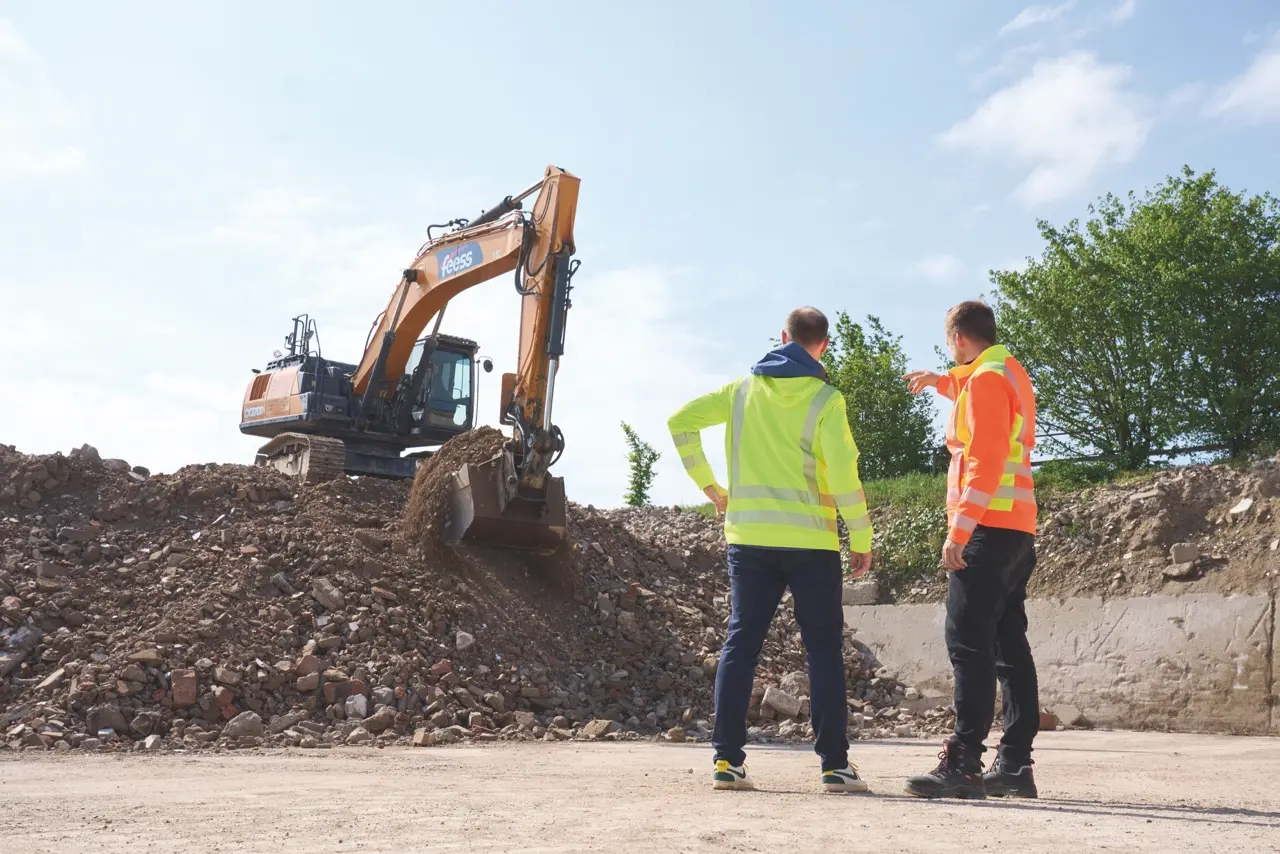
Eberhard Fritz guides Max-Frederick Gerken and new employees of Optocycle GmbH through the yard as part of their onboarding.

Would you like to find out how Optocycle can make your recycling business more efficient and transparent? Schedule a non-binding consultation now using THIS LINK.